
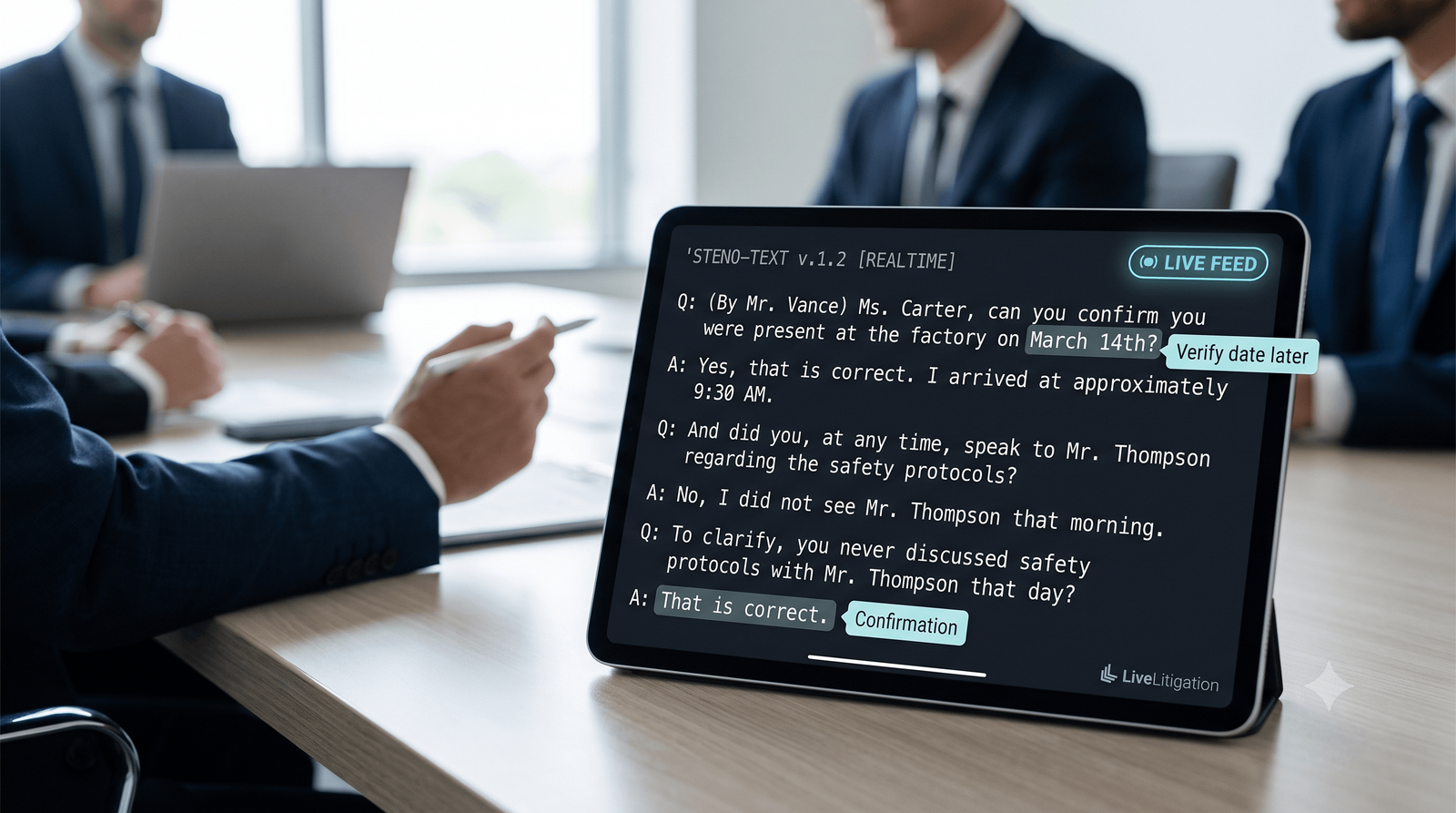
Realtime court reporting is the process of converting spoken testimony into a written transcript instantly, as the words are spoken, and streaming that transcript live to attorneys, witnesses, and other participants. Instead of waiting hours or days for a rough draft, everyone in the proceeding can read the record in real time, line by line.
It's one of the most valuable tools in a modern deposition, hearing, or trial, and it's increasingly expected by litigation teams. Here's how it works and when it makes sense to use it.
How realtime court reporting works
A certified stenographer (court reporter) writes testimony on a stenotype machine. Their CAT (Computer-Aided Transcription) software translates those keystrokes into English text on the fly. That text is then delivered to attendees' screens through realtime software, so a question and answer appear moments after they're spoken.
Participants can typically search the transcript, highlight key testimony, add private notes, and export the feed when the session ends, turning a passive transcript into an interactive working document.
Realtime vs. a standard transcript
With traditional reporting, you receive the transcript after the proceeding. Realtime gives you the record during it, which changes how attorneys work: you can confirm exactly what a witness said before moving on, catch a misstatement immediately, and coordinate with co-counsel silently while the deposition continues.
Local vs. online realtime delivery
Realtime can be delivered two ways. Local (offline) streaming sends the transcript over a private in-room network with no internet required, which is ideal for courthouses and conference rooms with unreliable Wi-Fi. Online delivery streams the transcript securely over the internet for remote and hybrid proceedings. The best platforms support both and let you switch between them. (LiveLitigation's realtime court reporting does this, and even includes a pre-configured wireless router for local mode.)
Who uses realtime, and why
- Attorneys use it to follow testimony precisely and prepare cross-examination in the moment.
- Court reporters and agencies offer it as a premium service that wins and retains clients.
- Witnesses and experts benefit from readbacks without stopping the proceeding.
It's especially valuable in complex depositions, technical expert testimony, and multi-party matters where an accurate, shared record matters most.
What you need for realtime court reporting
A realtime-certified court reporter, CAT software, and a realtime delivery platform that attendees can join from a laptop, tablet, or phone. For remote depositions, that platform is often part of a full online deposition platform that also handles video and electronic exhibits.
Frequently asked questions
Is realtime the same as a rough draft? No. A rough draft is an unedited transcript delivered after the proceeding. Realtime appears live, as testimony is spoken.
Do I need internet for realtime? Not necessarily. Local mode delivers the transcript over a private network with no internet connection required.
Can multiple attorneys view the realtime feed at once? Yes. Modern platforms stream the same transcript to many attendees simultaneously, in the room or remotely.
Want to see interactive realtime in action? Explore LiveLitigation Realtime Court Reporting or request a demo.