How to Host an eSuite Room
The controls only a host has: changing roles and permissions during a proceeding, running the recording, and managing who is in the room.
This guide covers what a host can do from inside a room, as distinct from setting the room up beforehand. Most of it exists for one reason: a proceeding rarely starts with everyone correctly labelled, and a host needs to fix that without stopping the deposition.
For scheduling a room, building the attendee list, and choosing features and recording layouts before the event, see How to Create an eSuite Room.
1. Who Counts as a Host
Two kinds of people hold host controls:
- An account host - someone signed in to your eSuite account who opened the room. The room menu shows Room: 1234567 (Host) for them.
- A co-host - an attendee a host promoted, either on the attendee list before the event or from inside the room. They get the same in-room controls for this session.
The difference matters in exactly one place: only an account host can take the host role back off a co-host. That is deliberate, so a co-host cannot remove the person who promoted them.
2. Open an Attendee’s Card
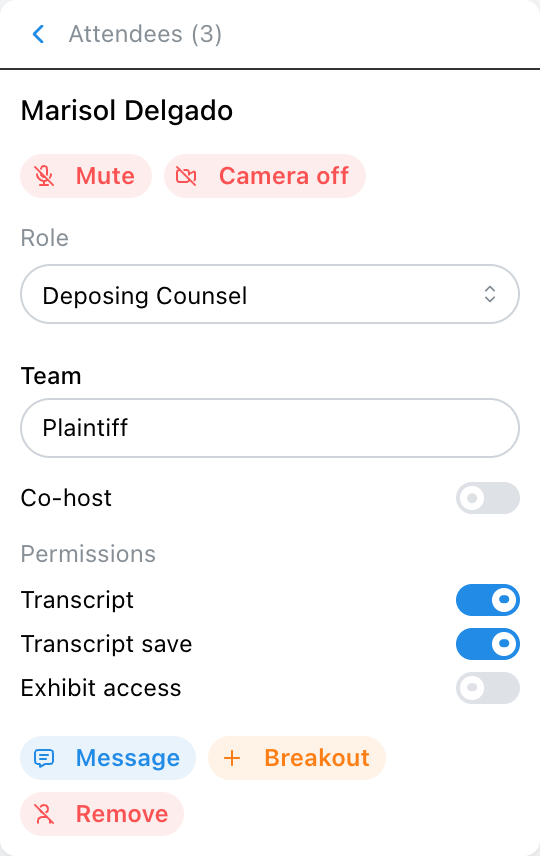
Almost every control over a person lives in one place. Open the attendee list and click the person’s row. Their card opens over the list, with a Back arrow and the attendee count at the top.
On the row itself, each person shows a role chip. When someone has no role yet, which is exactly what a guest who just joined looks like, the row shows + Role instead. That is the affordance to look for when a witness arrives as a guest.
3. Change Someone’s Role During the Proceeding
On the card, the Role dropdown sets what part this person plays: Witness, Videographer, Deposing Counsel, Opposing Counsel, Court Reporter, or no role at all. Choosing one opens a confirmation that spells out what the change actually does before you commit to it.
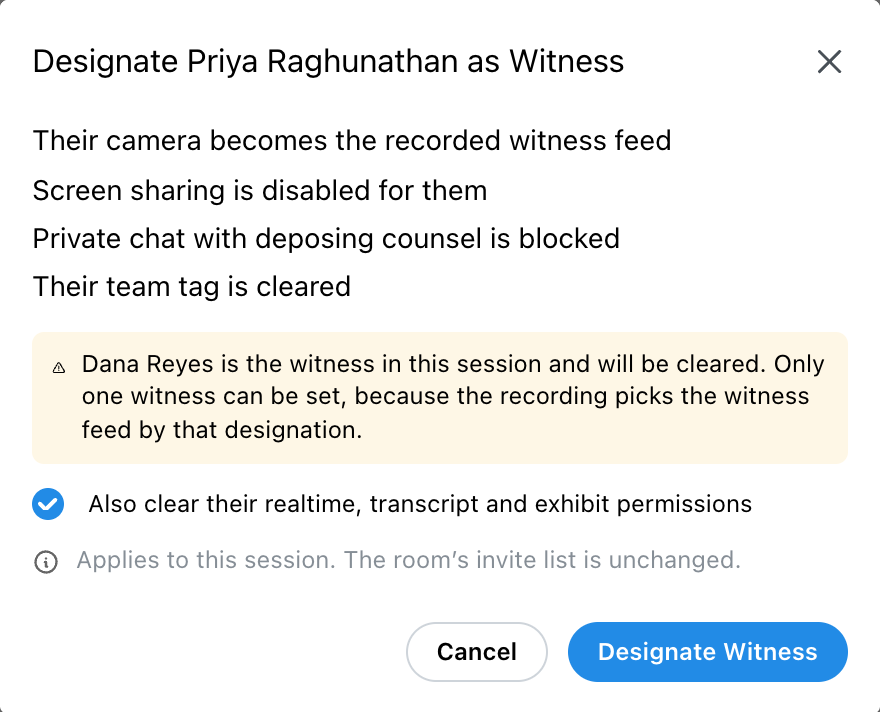
Designating a Witness, for example, states plainly:
- Their camera becomes the recorded witness feed
- Screen sharing is disabled for them
- Private chat with deposing counsel is blocked
- Their team tag is cleared
The change takes effect immediately. The person is told what happened in their own terms, so a witness whose screen share button just disappeared knows why.
GOOD TO KNOW: Designating a witness clears the previous one
A room can only have one witness, because the recording picks the witness feed by that designation. If someone else already holds it, the confirmation names them and tells you they will be cleared. It does not block you, since blocking mid-proceeding would be worse, but it does mean the witness-focused recording follows whoever was designated last.
BEST PRACTICE: Designate the witness before you start recording
The witness camera is chosen by this designation, so a recording started before anyone is designated has no witness feed to follow. If a witness joins as a guest, promote them first, then start the recording.
4. Set or Change a Team
The Team field on the card tags someone to a side, such as Defense or Plaintiff. Same-team attendees get a private team chat and can share exhibits with just their team. Your account’s saved team names appear as suggestions, and you can type a new one for an unusual party structure.
For a witness the field is replaced by a line reading Witnesses are never on a team. That is what preserves the separation between counsel and the witness: a witness on the Defense team would receive the Defense team chat.
5. Grant and Remove Permissions
Under Permissions, three switches control what an attendee can reach:
- Transcript - see the live realtime transcript.
- Transcript save - save their own copy of it.
- Exhibit access - upload and download exhibits.
These take effect immediately and are the usual reason to open someone’s card. A guest who joins unlisted arrives with none of them, so granting transcript access is often the first thing a host does for arriving counsel.
Only the permissions the room actually has appear. A room with no transcript source does not show the transcript switches.
6. Make Someone a Co-Host
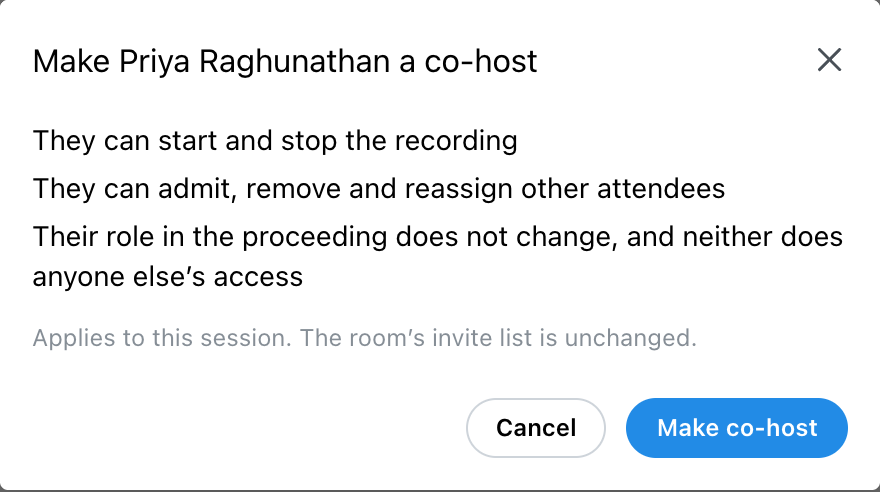
The Co-host switch on the card hands over the host controls. The confirmation is explicit about what that means:
- They can start and stop the recording
- They can admit, remove and reassign other attendees
- Their role in the proceeding does not change, and neither does anyone else’s access
Co-host is separate from the proceeding role, so deposing counsel acting as host is perfectly ordinary and their role survives the promotion.
BEST PRACTICE: Promote a second host before you need one
Everything in this guide stops being available the moment the only host drops off the call. Promoting a co-host early, usually the court reporter or the videographer, means a dropped connection does not leave the room with nobody who can admit a latecomer or stop the recording.
7. Mute, Camera, and Removing Someone
At the top of the card, Mute and Camera off act on that person straight away, and flip to Unmute and Camera on once applied. They are placed first because they are the most-used controls in a live room.
Remove disconnects the person from the session. They are told a host removed them. Removal ends their current connection; it does not edit the room’s attendee list, so a verified attendee can verify and rejoin.
GOOD TO KNOW: Removing is not the same as revoking access
If someone must not be able to come back, remove them and then lock the room, or edit the room’s attendee list. On its own, Remove only ends the connection they currently have.
8. Start and Stop the Recording
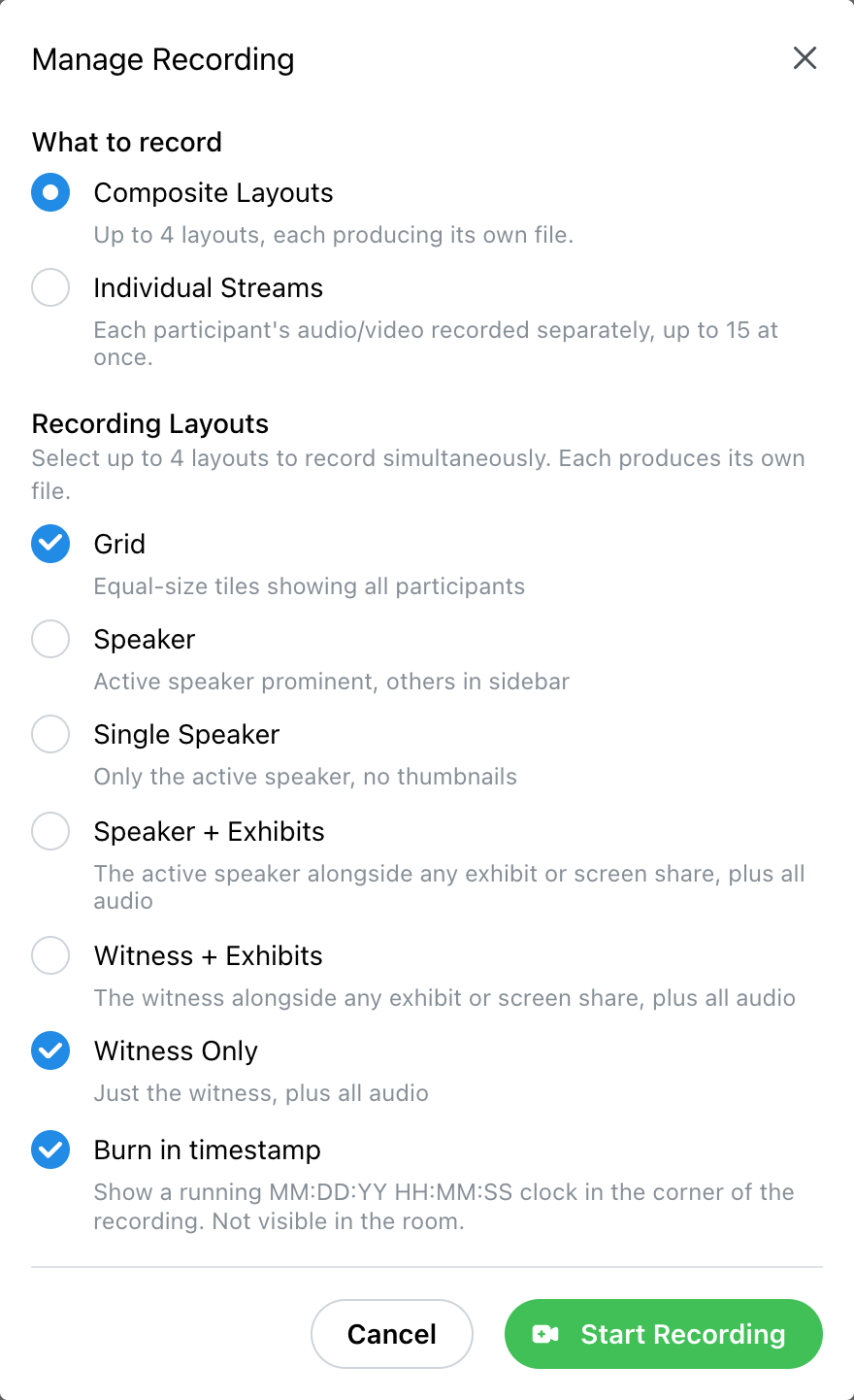
Open the room menu and choose Manage Recording. While something is running the entry reads Manage Recording (live) and is marked in red.
Before starting, the modal lets you confirm what this particular recording will capture: Composite Layouts or Individual Streams, which layouts to record, and whether to Burn in timestamp. These are the room’s settings, and changing them here applies to the recording you are about to start. Then press Start Recording.
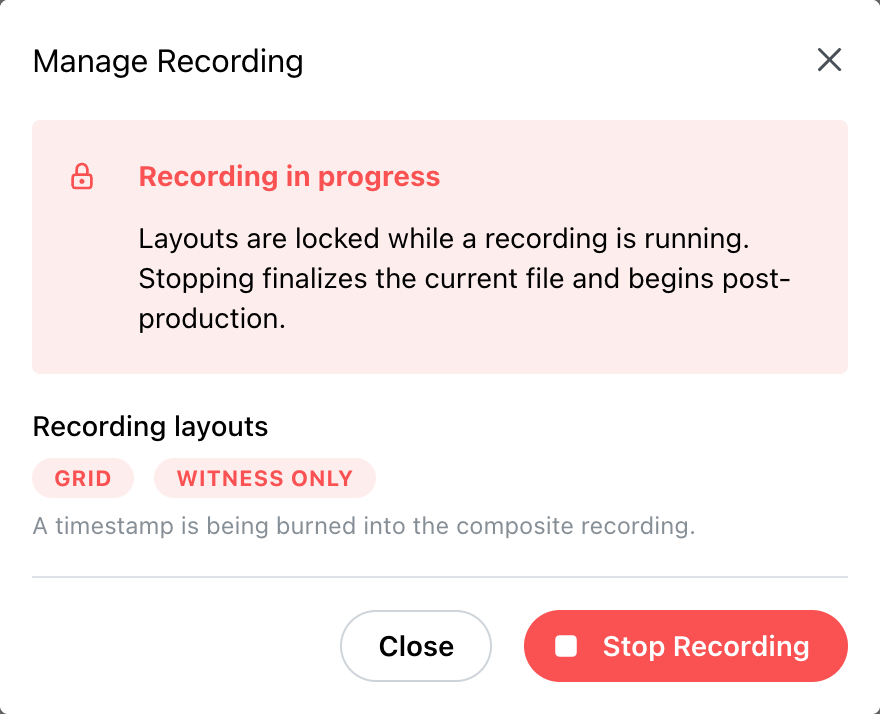
While a recording is running the modal shows which layouts are capturing, and notes that layouts are locked until it stops. Press Stop Recording to finalize the file and begin post-production.
BEST PRACTICE: Start and stop with the record
Starting when you go on the record and stopping when you go off it keeps breaks and off-record discussion out of the file entirely. Each on-record stretch produces its own recording, and afterwards you can select the parts in Recordings and choose Combine to join them into one file.
GOOD TO KNOW: Layouts cannot be changed mid-recording
Once a recording is running the layout selection is locked. If you started on the wrong layout, stop, change it, and start again. The two parts can be combined afterwards, so this costs you a seam rather than the recording.
9. Admit People from the Waiting Room
If the room uses a waiting room, arrivals are held until a host lets them in. They appear in their own section of the attendee list with a count. Each person has Admit to Room and Reject, and Admit All clears the queue at once.
BEST PRACTICE: Admit deliberately when the witness is unrepresented
The waiting room is most valuable in exactly the proceedings where an unexpected participant is a problem. Admitting one at a time lets you see who is arriving and give them a role before they are in the room.
10. Approve Screen Share Requests
When someone who cannot share on their own asks to, a prompt appears for the host reading “[Name] would like to share their screen” with Approve and Deny. It stays on screen for thirty seconds.
Verified attendees generally share without asking. The witness and the videographer cannot share at all, by design, and will not produce a request.
11. Lock the Room
From the room menu, Lock Room stops anyone else from joining. The same entry reads Unlock Room once locked. Locking does not remove anyone already present.
BEST PRACTICE: Lock once everyone is in and on the record
It is the simplest way to guarantee nobody wanders in mid-testimony, and it is one click to undo when someone needs to rejoin after a dropped connection.
12. Breakout Rooms
From an attendee’s card, Breakout starts a private side room with that person, and if breakouts already exist the card offers Add to [name] for each one. Counsel use these for a private word with their client without leaving the proceeding.
Deposing Counsel cannot take the witness into a breakout. That restriction is the point of the role and applies to hosts as well.
13. End the Session
Leaving offers two different things. Leave disconnects you and leaves the room running for everyone else. Below it, a host also sees End Meeting for All, which disconnects every participant and ends the session.
GOOD TO KNOW: Stop the recording before you end the meeting
Ending the meeting for everyone is the last thing to do, not the first. Stop the recording yourself so you know the file was finalized cleanly, then end the session.
What a Host Cannot Do
Several things are refused on purpose. Knowing them saves you hunting for a control that does not exist.
- Make the witness a host. They would hold host powers over their own testimony. Clear their role first if that is genuinely what you want.
- Give an observer a role or the host controls. Observers watch the stream and are not connected to the meeting. Changing that requires them to rejoin.
- Remove the host role as a co-host. Only an account host can, and never from another account host.
- Leave the room with no host. The last remaining host cannot be demoted.
- Change an attendee’s email address. The address is their identity, confirmed by a code sent to it. A host typing one in would assert an identity rather than verify it, so it is corrected on the room’s attendee list instead.
- Re-role someone signed in on your account. Account logins are not re-labelled from inside a room.
GOOD TO KNOW: In-room changes never edit the room itself
Everything here applies to the session in progress and to the record of it. None of it rewrites the room’s saved attendee list. For a multi-day matter, make the same corrections on the room afterwards, or day two starts exactly as day one did.
Explore the platform